
What Is the 5 Whys Method?

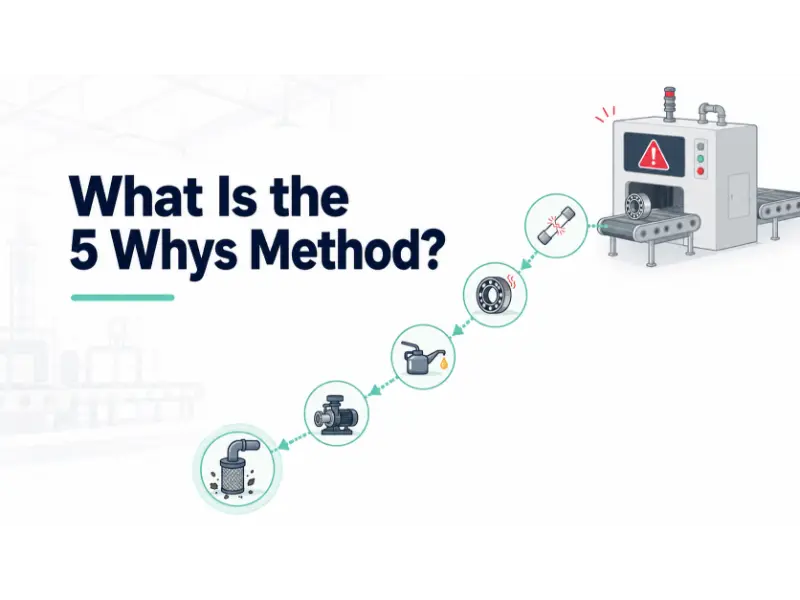
The 5 Whys method is a simple root cause analysis technique that works by asking “why” a problem happened over and over, usually about five times, until the answer points to an underlying cause rather than a surface symptom. It came out of the Toyota Production System, where Sakichi Toyoda used it to stop teams fixing the same fault twice.
Its appeal is that it needs no software, no data, and no special training. A team states the problem, asks why it happened, then asks why of each answer in turn, following one thread down until it reaches something worth acting on.
A worked example makes it concrete. Say a machine has stopped:
- Why did it stop? A fuse blew.
- Why did the fuse blow? The bearing seized.
- Why did the bearing seize? It ran dry of lubricant.
- Why did it run dry? The oil pump wasn’t circulating.
- Why wasn’t the pump circulating? Its intake was clogged with swarf.
Replace the fuse and the machine stops again next week. Fit a filter on the pump intake and it doesn’t. That gap, between the symptom everyone sees and the cause five questions down, is the whole point.
Five is a guide rather than a target. Some problems give up their cause in three whys, others take seven. The signal to stop is reaching a cause you can act on, rather than hitting a number.
The method has limits worth knowing. It follows a single line of reasoning, so it suits a narrow problem with a clear chain of events. When a failure has several causes at once, one thread of whys misses most of them, which is where a fishbone diagram works better. The common traps are stopping at a symptom, answering a why with a guess rather than evidence, and letting the chain end at operator error when the real cause is a process that let the error happen. As one of the most accessible root cause analysis tools, the 5 Whys earns its keep only when the cause it finds becomes an owned action that someone verifies.
EviView lets teams run a 5 Whys investigation digitally, capturing each question and answer in sequence, linking the root cause to an assigned action, and tracking it through to closure so the same problem doesn’t come back. Book a demo.
Written By:

Karol Dabrowksi, CEO
Karol Dąbrowski is the CEO of EviView, a digital daily management system used by leading manufacturing companies to improve efficiency, reduce downtime, and optimise production performance. With a strong background in manufacturing operations, Karol is focused on solving real-world shop floor challenges by enabling teams to turn operational data into actionable insights and unlock hidden capacity across their facilities.