
What Is Kaizen in Lean Manufacturing?

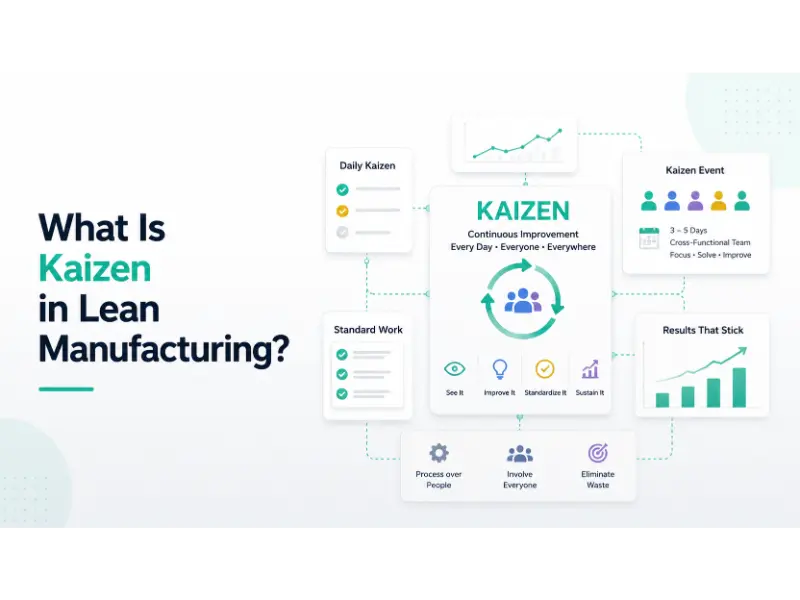
Kaizen is the Japanese practice of continuous improvement, and in lean manufacturing it means improving how work is done through small, steady changes made by everyone, every day, rather than through occasional big projects. The word translates roughly as change for the better, and the principle is that many tiny gains, sustained over time, deliver more than any single overhaul.
What makes an improvement kaizen is as much mindset as method. It is treated as part of everyone’s job, from the operator to the plant manager, and when something goes wrong the blame falls on the process rather than the person. Because the people closest to the work feel its friction first, kaizen pushes the job of spotting and fixing problems down to them. This also separates kaizen from kaikaku, the radical, top-down overhaul lean uses sparingly; kaizen is the incremental, everyday counterpart.
In practice it takes two forms. Daily kaizen is the steady trickle of small fixes woven into normal work, made by frontline teams as they go. A kaizen event, sometimes called a kaizen blitz, is the opposite shape: a focused, time-boxed burst, usually a few days, where a cross-functional team resets one process, often beginning at the gemba and working through a PDCA cycle. The two are complementary, and a healthy operation runs both.
One rule underpins all of it, captured by Taiichi Ohno: there can be no kaizen without a standard. A task done differently by every shift gives nothing stable to measure against, so kaizen depends on standard work for its baseline, and every gain that holds gets written back into the standard so the next improvement starts from the new normal. It sits firmly inside lean principles, with most kaizen aimed at removing waste.
Where kaizen stalls is usually the follow-through. Plants lean on the occasional event for a jolt of energy, the gains fade once everyone returns to their day job, and the daily habit never takes root. Kaizen sticks only when the improvement is followed through, written into the standard, and made visible enough that the next shift inherits it rather than reinventing it.
EviView gives teams a structured way to run kaizen events end to end, from logging the idea to assigning owners, tracking each action to closure, and locking the result into the standard so the gain holds across every shift and site. Book a demo.
Written By:

Karol Dabrowksi, CEO
Karol Dąbrowski is the CEO of EviView, a digital daily management system used by leading manufacturing companies to improve efficiency, reduce downtime, and optimise production performance. With a strong background in manufacturing operations, Karol is focused on solving real-world shop floor challenges by enabling teams to turn operational data into actionable insights and unlock hidden capacity across their facilities.