
What Is Continuous Improvement in Manufacturing?

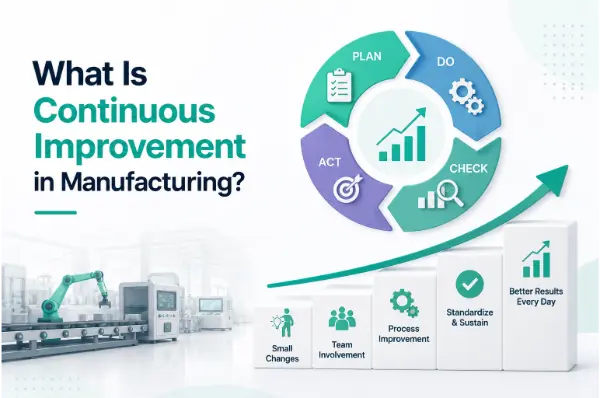
Continuous improvement in manufacturing is the practice of making small, steady changes to how a plant runs, instead of waiting for big one-off projects to fix everything at once. The aim is to remove waste, raise quality, and lift performance a little at a time, with the people doing the work driving most of the changes. It is often called by its Japanese name, kaizen.
The logic is that small gains compound. A single five-minute saving on a changeover looks trivial, but repeated every shift, across every line, it adds up to more than most transformation projects deliver, and it sticks because the floor owns it. The idea grew out of lean principles, where most of the effort goes into removing waste: the waiting, the rework, the excess stock, anything the customer would never choose to pay for.
Left unstructured, continuous improvement becomes a pile of disconnected quick fixes, so most plants give it a method. The PDCA cycle, plan, do, check, act, keeps each change small and evidence-based: test it, measure it, then standardise it or drop it, getting to the root cause rather than patching the symptom. Because what gets measured gets managed, teams tie each change to a hard number and learn to calculate OEE consistently, so a claimed improvement can actually be proven.
It helps to separate continuous improvement from a kaizen event. An event is a short, focused burst, a few days spent fixing one area. Continuous improvement is the everyday habit that runs between events and keeps the gains from slipping.
Where it usually breaks down is follow-through. Ideas get raised in a meeting and forgotten, actions have no owner, and successful changes are never written into the standard, so the next shift drifts back to the old way. Improvement only compounds when every idea is captured, assigned, tracked to completion, and built into how the work is done.
EviView gives teams one place to log issues and improvement ideas, assign and track actions, and standardise what works, tied straight into daily management so progress stays visible. Book a demo.
Written By:

Karol Dabrowksi, CEO
Karol Dąbrowski is the CEO of EviView, a digital daily management system used by leading manufacturing companies to improve efficiency, reduce downtime, and optimise production performance. With a strong background in manufacturing operations, Karol is focused on solving real-world shop floor challenges by enabling teams to turn operational data into actionable insights and unlock hidden capacity across their facilities.