
What Is Hoshin Kanri?

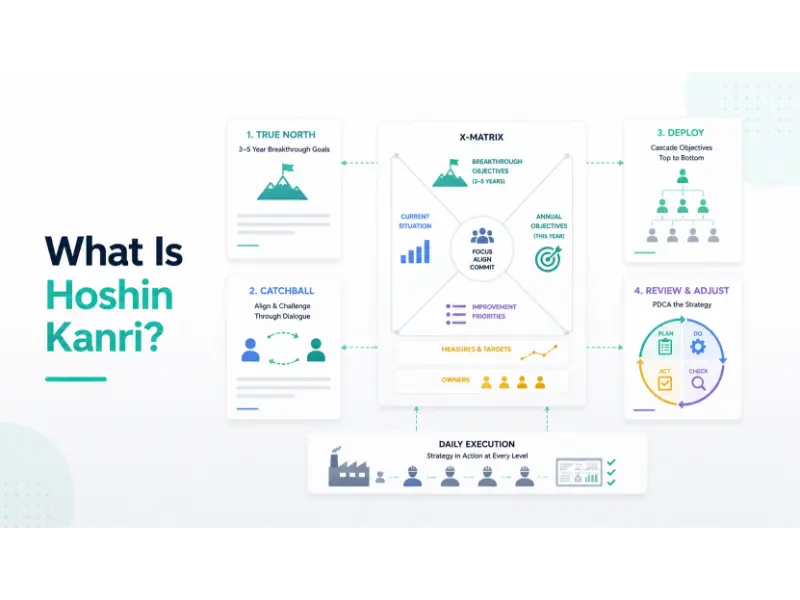
Hoshin Kanri is a strategic planning method that aligns an organisation’s few long-term breakthrough goals with the daily work of every level, by cascading objectives, metrics, and ownership from leadership down to the floor and back up again. The name translates roughly as compass management, and the whole point is to close the gap between a strategy written on a slide and what actually happens on the shop floor.
It exists because strategies usually fail in execution rather than in the writing. Leaders set a direction, and the people doing the work never see how their tasks ladder up to it. Hoshin answers that by forcing focus: rather than a sprawling list of priorities, leadership commits to three to five breakthrough objectives over a three to five year horizon, the True North, then carves out the slice of each to deliver this year.
What stops this being top-down command is a step called catchball. Objectives are thrown back and forth between layers of the organisation, negotiated and challenged until the people who must deliver them actually agree they’re realistic. That two-way exchange is what produces commitment rather than compliance. The result is captured on a one-page X-matrix, a visual management tool that links long-term goals, annual objectives, improvement priorities, measures, and owners on a single sheet anyone can read.
Hoshin is a cycle rather than a binder. One loop is usually annual, with monthly or quarterly reviews inside it, and it runs on the PDCA cycle: plan the year, execute, check progress against the measures, and adjust. Execution lives in the daily rhythm, where breakthrough objectives surface in the same tier meetings that review everyday performance, keeping strategy and operations connected.
It helps to separate hoshin from ordinary daily management. Hoshin is reserved for the vital few changes that move the business somewhere new; the routine work of keeping the plant running belongs to daily management rather than the X-matrix. Loading the matrix with business as usual is the quickest way to dilute it.
Where hoshin fails is usually focus and follow-through. Too many objectives, deployment imposed without catchball, a matrix drawn once and never reopened, or no review cadence, and the strategy quietly drifts back into a document nobody acts on.
EviView connects breakthrough objectives to daily execution, surfacing progress in tiered reviews, tracking each action to an owner, and keeping the whole picture visible from leadership to the floor. Book a demo.
Written By:

Karol Dabrowksi, CEO
Karol Dąbrowski is the CEO of EviView, a digital daily management system used by leading manufacturing companies to improve efficiency, reduce downtime, and optimise production performance. With a strong background in manufacturing operations, Karol is focused on solving real-world shop floor challenges by enabling teams to turn operational data into actionable insights and unlock hidden capacity across their facilities.