
What Is OEE in Manufacturing?

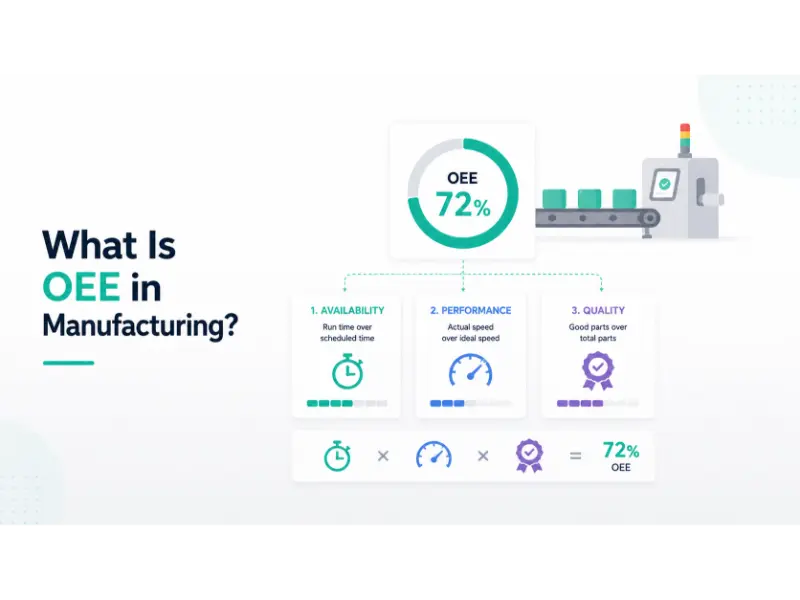
OEE, or Overall Equipment Effectiveness, is the standard measure of how much of the time a machine was scheduled to make good parts it actually spent doing so. It’s a single percentage built from three factors, and it shows both how much potential output a line is losing and where the loss is coming from.
The three factors each isolate a different kind of loss:
- Availability: the share of scheduled time the machine was actually running, eroded by breakdowns and changeovers.
- Performance: how close it ran to its rated speed, eroded by minor stops and slow cycles.
- Quality: the share of parts made right the first time, eroded by scrap and rework.
Multiplying the three, Availability times Performance times Quality, gives the OEE percentage. Because they multiply, a weak score in any one drags the whole number down: a machine that never stops but runs slow and scraps parts is not effective, however busy it looks.
A perfect 100% would mean only good parts at full speed with no stops, which no real line sustains. Around 85% is widely treated as world-class and the average manufacturer sits nearer 60%, so a sensible target depends heavily on the equipment and the product.
The real value of OEE lies beneath the headline figure. Each factor maps to specific, fixable losses, the so-called six big losses, from breakdowns and changeovers to minor stops and defects. A score on its own tells you something is wrong without saying what, which is why OEE works best paired with root cause analysis: the number shows where to look, the investigation shows why.
Where OEE goes wrong is usually consistency. If planned and unplanned stops are counted differently from shift to shift, or the ideal cycle time is a guess, the trend becomes meaningless. Manual logging makes it worse, arriving late and full of gaps, so the score gets argued over in the morning meeting instead of acted on. For the full method, the calculate OEE guide walks through a worked example.
EviView captures availability, performance, and quality live at the line, attaches a reason to every loss, and feeds it into real-time analytics so teams act on the OEE number while the shift is still running. Book a demo.
Written By:

Karol Dabrowksi, CEO
Karol Dąbrowski is the CEO of EviView, a digital daily management system used by leading manufacturing companies to improve efficiency, reduce downtime, and optimise production performance. With a strong background in manufacturing operations, Karol is focused on solving real-world shop floor challenges by enabling teams to turn operational data into actionable insights and unlock hidden capacity across their facilities.