
Beyond the Dashboard: How Digital Tierboards Transform from “Status Reports” to “Action Engines”

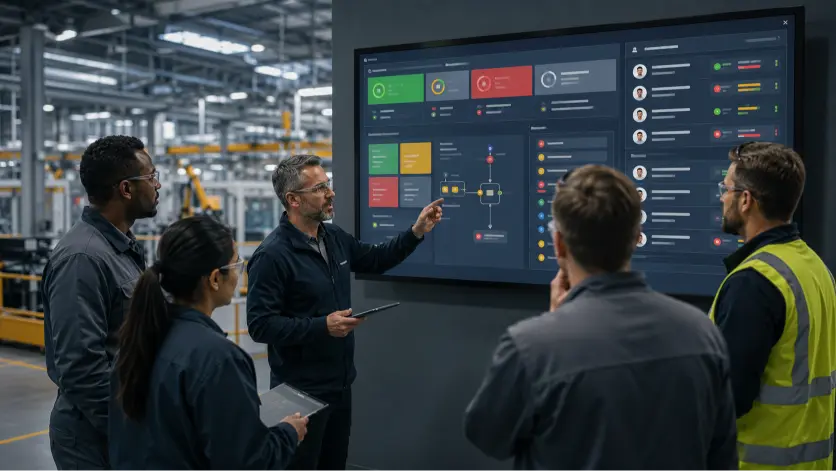
For Operations Directors, Plant Managers and CI Leaders who are tired of watching the same problems resurface in every morning meeting.
Every Monday morning, somewhere in a manufacturing plant, a team gathers around a screen. The dashboard is pristine. Green, amber, red. Someone explains why last week’s OEE dipped to 68%. Actions are noted. The meeting ends. By Friday, half of those actions are still open – and next Monday, the same conversation begins again.
This is not a data problem as you have more data than ever. This is a decision problem. And it’s costing you more than you think.
Research from McKinsey shows that companies excelling at fast, high-quality decision-making are twice as likely to deliver returns of 20% or more – and the average Fortune 500 company loses an estimated $250 million annually to ineffective decision processes (source). Yet, most organizations keep adding data tools without fixing the decision architecture underneath them.
According to Gartner, fewer than half of data and analytics leaders say their teams are effectively delivering business value, and analytics influence barely half of the decisions they’re supposed to inform. More data, more dashboards, and somehow, less action (source).
The gap between knowing and doing is what separates a status report culture from an action engine culture. Digital tierboards, built and deployed correctly, are the mechanism that closes that gap. Here’s how.
The Real Problem Isn’t a Lack of Data – It’s Decision Latency
Let’s assume you’re running tiered daily management meetings: Tier 1 on the floor, Tier 2 with middle management, Tier 3 with senior leadership – you already know the theory. Cascade information up, drive accountability down, solve problems at the right level. The framework is simple…
So why does it so often devolve into a status update ritual?
The answer lies in what researchers call Decision Latency, the invisible interval between the moment an issue occurs and the moment someone commits resources to fix it. It is the gap between detection and action and in most organizations, this gap is neither measured nor managed (Gartner, 2026; McKinsey, 2024). In traditional manufacturing environments, the Decision Latency Index (DLI) can be 7 days or more. In digital-first organisations, it’s 1-3 days (The Agile Brand Guide, 2026). That gap represents days of waste, missed production windows, and compounding quality issues.
“Adding more BI tools often increases latency rather than reducing it. Executives get more visibility but not more velocity. The result is decision friction – teams waiting for clarity rather than acting with courage.” – Karol Dabrowski, CEO at EviView
The root cause is almost always the same: dashboards are built to report on the past, not to drive action in the present. When data arrives outside the cadence at which decisions are actually made, it doesn’t inform action … it just adds noise.
The transition from dashboard-as-report to tierboard-as-engine requires a different architecture entirely.
What Makes a Tierboard an “Action Engine”?
A traditional dashboard answers the question: What happened? An action engine answers: What needs to happen right now, who owns it, and is it getting done?
The distinction sounds simple, but the operational difference is significant. Here are the four characteristics that separate a status-report culture from an action-engine culture:
1. Exceptions Over Averages
Most dashboards surface averages – last week’s OEE, this month’s downtime trend. Action engines surface exceptions – the machine that has failed three times this shift, the line where IPC completion is running 40 minutes behind, the safety near-miss that happened during the weekend handover.
When your Tier 1 board highlights risks for the current shift before they escalate, you shift from reactive firefighting to anticipatory management. The question changes from “what went wrong?” to “what might go wrong in the next two hours?”
2. Decision-Ready Data
Decision-ready data is information that allows an Operations Director to act before a problem compounds. It involves continuous data transformation, real-time visibility into task progress, and standardized insights that guide human decision-making without requiring a 30-minute data reconciliation exercise.
The most effective tiered management systems follow a 40/20/40 rule: 40% of effort invested in preparation (sharing the right data before the meeting), 20% in the actual meeting (deciding and solving), and 40% in follow-up (tracking whether actions were completed). Most organisations invert this – spending 80% of their meeting time explaining data and almost nothing on structured follow-through.
3. Owner-Tagged Actions with Due Dates
An action without an owner is a wish. A Tier 1 board that lists issues without assigning them to a named individual and a specific time for resolution will always drift toward status reporting. The physical or digital equivalent of “someone should look into this” is the single biggest contributor to the action gap.
Effective tierboards make ownership visible and non-negotiable. When an escalation happens from Tier 1 to Tier 2, it carries a full audit trail: what the issue is, when it occurred, what was tried, and who owns resolution at the next level.
4. Structured Escalation Pathways
Escalation is not a failure – it is a system. When an issue cannot be resolved at Tier 1, it should be documented and escalated to Tier 2 automatically and without friction. This ensures that problems don’t linger at the wrong level or fall through the cracks between shifts.
The interconnected nature of a well-designed tiered structure creates a single source of truth from the shop floor to the boardroom, one that reflects reality in real time rather than in next week’s report.
The Anatomy of a Tiered Management System That Actually Works
For context, a well-functioning tiered management system typically operates across three or four levels:
| Tier 1: Frontline Staff & Team Leads: Daily/per-shift stand-ups (15 min). Focus: SQDP (Safety, Quality, Delivery, People). Outcome: Immediate countermeasures and owner-tagged actions. Tier 2: Middle Management & Support: Daily. Focus: Systems of work and cross-functional bottlenecks. Outcome: Resource allocation and escalation resolution. Tier 3: Senior Leadership: Weekly/Monthly.Focus: Strategic initiative progress.Outcome: Alignment between operational performance and business goals. Tier 4: Executive Committee: Monthly/Quarterly. Focus: Long-term sustainability and market positioning.Outcome: Strategic direction and competitive positioning |
The problem isn’t the structure – it’s the execution. Without digital infrastructure that connects these tiers, each level operates on its own version of the truth. Tier 1 updates a whiteboard. Tier 2 reviews a spreadsheet that’s four hours old. Tier 3 sees a PowerPoint prepared over the last few days. By the time an issue reaches someone with the authority to resolve it, the window for intervention has often closed.
Digital tierboards solve this by ensuring that updates at one level are reflected immediately across the system. A near-miss flagged at Tier 1 doesn’t wait for tomorrow’s Tier 2 meeting – it triggers a notification, creates an action, and tracks resolution in real time.
The Hidden Cost: What’s Lost Between Shifts
Of all the pain points that lead operations teams to look for better solutions, shift handover is the one that comes up most consistently. And it’s not hard to understand why.
Shift changes are, by their nature, moments of maximum information loss. The outgoing team knows what happened. The incoming team doesn’t. If the handover is verbal, it’s incomplete. If it’s a paper log, it’s illegible, outdated, or buried under the previous three weeks of entries. If it’s an email, nobody reads it until something has already gone wrong.
Approximately 70% of repair time in high-speed manufacturing environments is spent on communication and diagnostics rather than actually fixing things, the so-called “Information Hunt”(Netscout, 2025). Shift handover is one of the primary contributors to this waste.
“The incoming team shouldn’t have to spend the first 45 minutes of a shift piecing together what happened during the last one. That’s not a knowledge problem, it’s a systems problem.” – Maheep Bhagwani, Senior Business Analyst at EviView
A digital daily management platform eliminates this friction by giving the incoming team a structured, automatically populated handover: open actions, recent incidents, machine status, IPC completions in progress, and any issues flagged for escalation. The shift can start with clarity rather than confusion.
Why Most Digital Transformation Efforts Stall
You may have been here before. A new system is piloted on one line. The results look promising. Rollout is announced. And then … nothing. The system gets used for a few weeks, adoption drops off, and the team quietly goes back to the whiteboard and the spreadsheet.
McKinsey puts the failure rate for digital transformation initiatives at 70% (McKinsey & WFE, 2018). Gartner puts it closer to 80% for organisations trying to scale (World Economic Forum, 2026; Garner, 2026). The term “Pilot Purgatory” – where promising pilots never reach full deployment, is the most common pattern (McKinsey, 2018). And the reasons are predictable:
- The tool is designed for reporting, not for the people doing the work,
- KPIs tracked are chosen because they’re easy to measure, not because they drive action,
- Training is treated as an event rather than an embedded habit,
- The system doesn’t connect to how decisions are actually made on the floor,
The organisations that succeed at digital lean transformation share one characteristic: they treat workforce capability as critical infrastructure, not as a one-off change management exercise. Technology enables the system. People sustain it.
This is why methodologies like Toyota Kata matter alongside digital tools. The Improvement Kata – understand the challenge, grasp the current condition, establish the next target condition, experiment toward it – provides the scientific thinking framework that gives data meaning. Without it, even the best dashboards become wallpaper (Lean Enterprise Institute, 2021).
The 2026 Horizon: Agentic AI and the Self-Correcting Operation
Looking ahead, the next evolution of the action engine is already beginning to take shape. Agentic AI – systems that can perceive, reason, and act with a degree of autonomy – is starting to remove the last remaining friction from the fault-to-fix cycle.
In practical terms, this means daily reports generated automatically from operational data. It means maintenance instructions pushed to a technician’s device the moment a machine crosses a performance threshold. It means quality deviations flagged before they become scrap. And it means all of this happening within the structure of your tiered management system, not alongside it.
The organisations that will lead in this environment are not the ones with the most sophisticated AI. They are the ones that have already built the operational discipline: clear ownership, structured escalation, decision-ready data – that allows AI to act on real signals rather than noise.
The goal, increasingly within reach, is an operation that is self-learning, self-correcting, and self-executing, where every tier meeting is a moment of measurable progress, not a recap of yesterday’s problems.
Where EviView Fits In
EviView is a Digital Daily Management System built for exactly this transition: from status-report culture to action-engine culture.
Designed for manufacturing environments across pharmaceutical, medical device, chemical, food and beverage, cosmetics, renewable energy, and beyond, EviView brings together the key pillars of operational execution in a single platform:
- Tier boards and visual management: Real-time dashboards that surface exceptions, not just averages, with owner-tagged actions and built-in escalation pathways,
- Digital shift handover and logbooks: Structured, automatically populated handovers that eliminate the information hunt at every shift change,
- Safety, quality, and incident reporting: Proactive reporting tools that increase visibility without increasing admin burden,
- SQDP tracking across all tiers: From Tier 1 frontline stand-ups to Tier 3 senior leadership reviews, all connected in a single source of truth,
- Continuous improvement workflows: Idea Cards, 5 Whys, and root cause tools embedded in daily operations – not bolted on as a separate initiative,
EviView is not another reporting layer. It is the operational infrastructure that connects what happens on the floor with the decisions that need to be made – at the right level, at the right time, with clear accountability.
| If your daily operational meetings are surfacing the same issues week after week. if your shift handovers are losing critical information. if your teams are spending more time collecting data than acting on it – the problem isn’t discipline or culture. It’s the system. And the system can be fixed. |
Ready to see how EviView works in your environment?
Talk to our team about how EviView can help you close the action gap – and turn your tier meetings from status reports into the most productive 15 minutes of your day.
www.eviview.com
About EviView
EviView is a digital daily management platform designed for manufacturing environments. We help operations teams in pharmaceutical, medical device, chemical, food and beverage, cosmetics, renewable energy, and beyond move from reactive reporting to proactive, accountable execution.
Written By:

Karol Dabrowksi, CEO
Karol Dąbrowski is the CEO of EviView, a digital daily management system used by leading manufacturing companies to improve efficiency, reduce downtime, and optimise production performance. With a strong background in manufacturing operations, Karol is focused on solving real-world shop floor challenges by enabling teams to turn operational data into actionable insights and unlock hidden capacity across their facilities.